
Readiness · Market Entry Framework
Are You Ready for the U.S. Market? Assess Before You Expand
A practical framework for identifying the gaps that can slow or derail U.S. healthcare market entry.
- What is it?
- U.S. market readiness framework
- Who is it for?
- Global health innovators
- Why is it useful?
- Identify readiness gaps early

About
The United States represents an enormous commercial opportunity for health technology, medtech and life sciences companies. But opportunity and readiness are not the same thing.
A company may have regulatory approval in another market, strong clinical results, experienced leadership and commercial success at home – and still discover that its business model does not translate cleanly into the U.S.
The U.S. healthcare system is decentralized, fragmented and shaped by different combinations of payers, providers, employers, health systems, clinicians and patients. Entering successfully requires more than finding a distributor or opening a U.S. office. It requires understanding how your product will be bought, paid for, implemented and adopted.
That is why readiness should be assessed before significant capital is committed.
START WITH BUSINESS VIABILITY
The first question is not simply:
Can we sell this in the U.S.?
A better question is:
Can this product create sustainable value within the way U.S. healthcare actually works?
A business viability assessment examines whether the technology, commercial model, evidence and implementation strategy align with the expectations of U.S. buyers. It should help identify gaps early – before they become expensive surprises.
Four areas deserve particular attention: regulatory alignment, reimbursement and economics, clinical and operational evidence, and implementation.
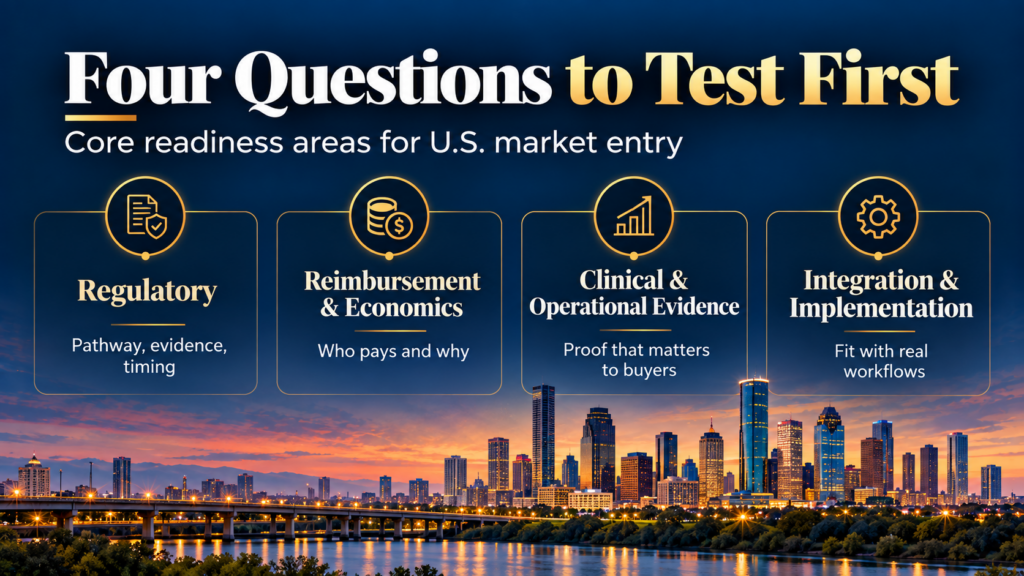
FOUR QUESTIONS TO TEST FIRST
REGULATORY
Do you understand the U.S. regulatory pathway for your product?
For medical devices, that may involve pathways such as 510(k), De Novo or Premarket Approval depending on the device and its risk classification.
The important readiness question is not simply whether you have regulatory experience. It is whether you understand your specific U.S. pathway, evidence requirements, timing and cost.
REIMBURSEMENT & ECONOMICS
Who pays for your product or service?
Does an existing payment pathway support adoption? If not, can the buyer justify the purchase through savings, revenue, improved outcomes, operational efficiency or another measurable source of value?
A company does not necessarily need a dedicated reimbursement code to succeed, but it does need a clear economic story.
CLINICAL & OPERATIONAL EVIDENCE
Is your existing evidence meaningful to the U.S. buyer you are targeting?
International clinical data may be highly valuable, but potential U.S. customers may also want evidence showing how the product performs within their own workflows, patient populations and operating environment.
That may mean pilots, validation studies, reference sites or other localized evidence.
INTEGRATION & IMPLEMENTATION
Can the product fit into existing systems and workflows?
For digital solutions, this may include interoperability, data security, privacy and integration with existing clinical or administrative systems. For medical devices, it may include training, workflow, infrastructure, maintenance and procurement requirements.
A product that is difficult to implement creates commercial friction even when its underlying technology is strong.
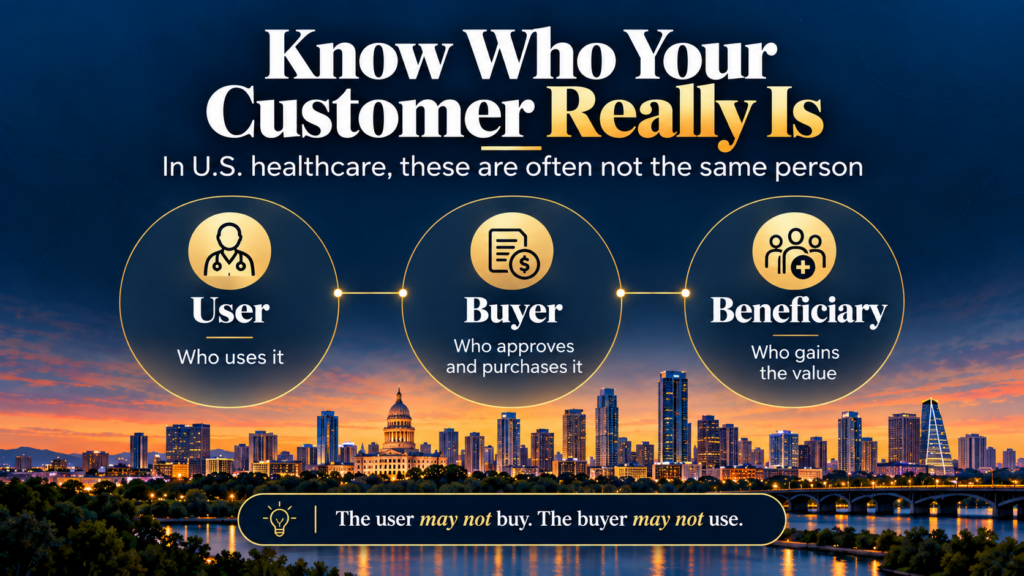
KNOW WHO YOUR CUSTOMER REALLY IS
One of the most common market-entry mistakes is assuming the user is the customer.
In U.S. healthcare, the user may not buy, the buyer may not use, and the beneficiary may not pay. That means companies need to understand several stakeholders at the same time.
USER
Who actually uses the product?
This may be a clinician, technician, patient or care team. A product may be loved by the end user but still struggle if the buying organization does not see enough value.
BUYER
Who approves and purchases it?
The buyer may be a hospital administrator, procurement team, department leader, physician champion, payer, employer or health system executive.
BENEFICIARY
Who gains the clinical, financial or operational value?
The beneficiary may be the patient, provider, employer, payer or health system. Sometimes the party receiving the greatest benefit is not the party paying for the solution.
A strong U.S. value proposition connects all three.
It should be clear who uses it, who buys it and who benefits — and why each one has a reason to care.
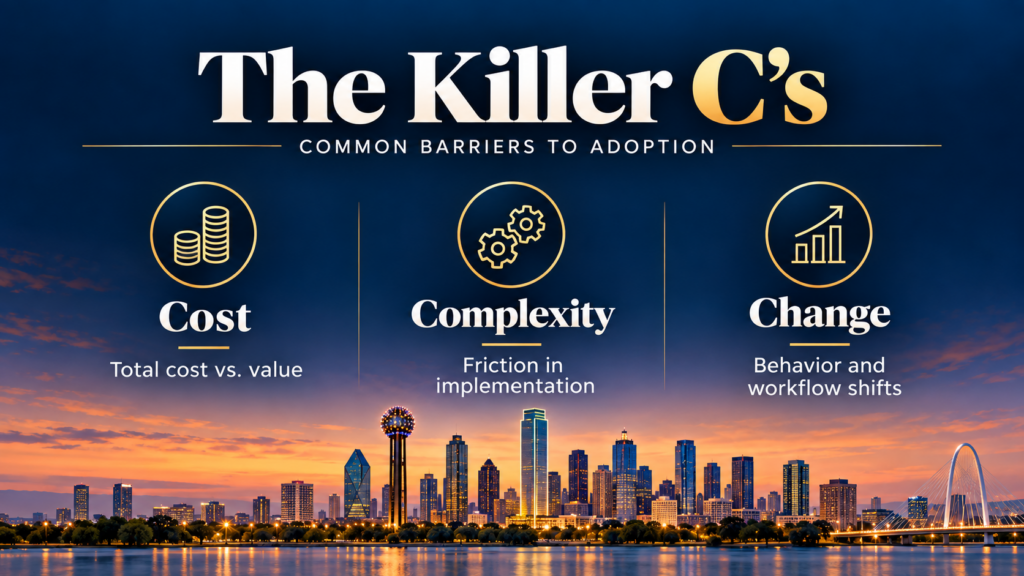
THE KILLER C’S
Even a strong product can encounter three recurring barriers once it reaches a healthcare organization: Cost, Complexity and Change.
COST
Purchase price is only one part of the equation.
Buyers may also consider implementation, integration, training, maintenance, staffing and workflow disruption.
The real question becomes:
What is the total cost – and what value does the organization receive in return?
COMPLEXITY
Healthcare organizations already operate in complicated environments.
Every new integration, interface, training requirement or implementation step adds friction.
Reducing complexity increases the chance that a promising pilot can become a repeatable deployment.
CHANGE
A product may be clinically valuable and technically sound but still fail if it demands too much behavior change.
Clinicians and healthcare staff already work within highly structured and often overloaded workflows. Successful solutions make adoption easier, not harder.
TEST YOUR READINESS
Before moving forward, a company should be able to answer several basic questions:
- Who is our first customer?
- Who makes the buying decision?
- Who pays?
- What problem are we solving?
- What evidence will the buyer require?
- What is our U.S. regulatory path?
- What is our economic value?
- How difficult are we to implement?
- What workflow must change?
- Who are our early adopters?
- What data will we collect?
- What is our first regional market?
- How much time and capital can we commit?
You do not need every answer before beginning. But you should know which answers you do not yet have.
That is the purpose of readiness.
START SMALL ENOUGH TO LEARN
The U.S. market is too large and too fragmented to approach as one national launch.
A focused entry strategy allows companies to test assumptions before scaling. That may mean choosing one health system, one clinical use case, one customer segment, one payer type or one regional ecosystem.
A regional approach can provide the relationships, pilots, reference customers and operating experience needed to learn what works before committing resources nationally.
For many international companies, Texas offers several different starting points depending on what they need — from clinical validation and research to technology partnerships, investment and commercialization.
The right entry point is the one that allows the company to learn quickly without burning capital unnecessarily.
READINESS IS NOT A YES/NO QUESTION
Market readiness is rarely simply ready or not ready.
Most companies sit somewhere in between. A company may be strong clinically but weak commercially. It may understand regulation but not reimbursement. It may have a compelling technology but no clear buyer, or strong international evidence but no U.S. reference customer.
That does not necessarily mean the company should wait.
It means the company should understand what is ready, what is not, and what must be solved next.
The purpose of readiness work is not to create another hurdle. It is to identify the gaps early enough to address them strategically.
YOUR NEXT MOVE
Before asking:
How quickly can we launch in the U.S.?
Ask:
What do we need to prove first?
Identify the gaps. Prioritize them. Determine what can be addressed before market entry and what needs to be tested through actual market engagement.
Then build the U.S. strategy around those answers.
Good preparation does not eliminate uncertainty.
It makes uncertainty manageable.
Articles, Tools & Additional Resources
Business Viability Assessment
Based in Austin, Green Room Technologies is a specialized consulting, marketing, and healthcare technology firm that helps life science and…
U.S. Readiness Assessment
Headquartered in Austin, Texas, US Trade Consult is a leading international market entry and business development consulting firm that…
Disclaimer:
Prepared by LoneStar LaunchPad / Green Room Technologies for educational and informational purposes. This resource provides general guidance related to U.S. healthcare market readiness and commercialization. It does not constitute medical, legal, regulatory, financial or other professional advice. Regulatory pathways, reimbursement requirements, procurement expectations and market conditions vary by product, organization and circumstance. Companies should seek appropriate professional guidance for their specific situation.